If you run an online business, you know that money needs to move fast. You cannot wait for a slow bank to say “yes” to your spending. This is why many people look for a cardupnow vs virtual card providers comparison. They want to know which tool will help them win in a world where ad accounts get banned every day.
In the world of the best virtual card providers, there are many choices. Some are cheap, while others are built for high-power media buying. When you do a virtual card comparison, you quickly see that not every card is the same. Some cards get rejected by big sites like Facebook or Google. Other cards charge you hidden fees every time you buy a coffee or pay for a tool.
By looking at cardupnow vs virtual card providers, you are making a smart choice for your wallet. You are finding a way to pay for ads and tools without using your own private bank details. This keeps your money safe and your business growing. In this guide, we will look at a prepaid card comparison to see which one deserves your trust in 2026. Whether you need a virtual visa vs mastercard, we have the answers you need to start spending today.
The Power of Control: Why Move to Virtual Cards?
If you have ever shopped online or managed a digital subscription, you know the worry of a “Payment Failed” alert or a surprise charge. Traditional bank cards are often too slow and rigid for the fast-moving digital world. When you look at the best virtual card providers, you see that they solve this by offering tools designed for total control over your spending. Using your primary bank card for every online service is a major security risk. If one site has a data breach, your entire bank account could be in danger.
A prepaid card comparison shows that dedicated virtual cards act as a digital shield. They separate your main savings from your daily spending. Because you can set exact limits on each card, you never have to worry about a “bill shock” or being overcharged by a subscription you forgot to cancel. This is why many people say the cardupnow vs virtual card providers debate is so important for anyone looking to manage money more safely.
When you use a high-quality online payment card, you are getting more than just a 16-digit number. You are getting “payment peace of mind.” High-trust providers ensure their cards work smoothly across global websites without getting flagged or blocked. In our virtual card comparison, we found that speed is also a major factor. You can create a new card in seconds for a specific store or service and start using it right away. Whether you are buying groceries online or paying for a professional tool, a reliable virtual visa card is the first step to smarter spending.
The Deep-Dive Comparison
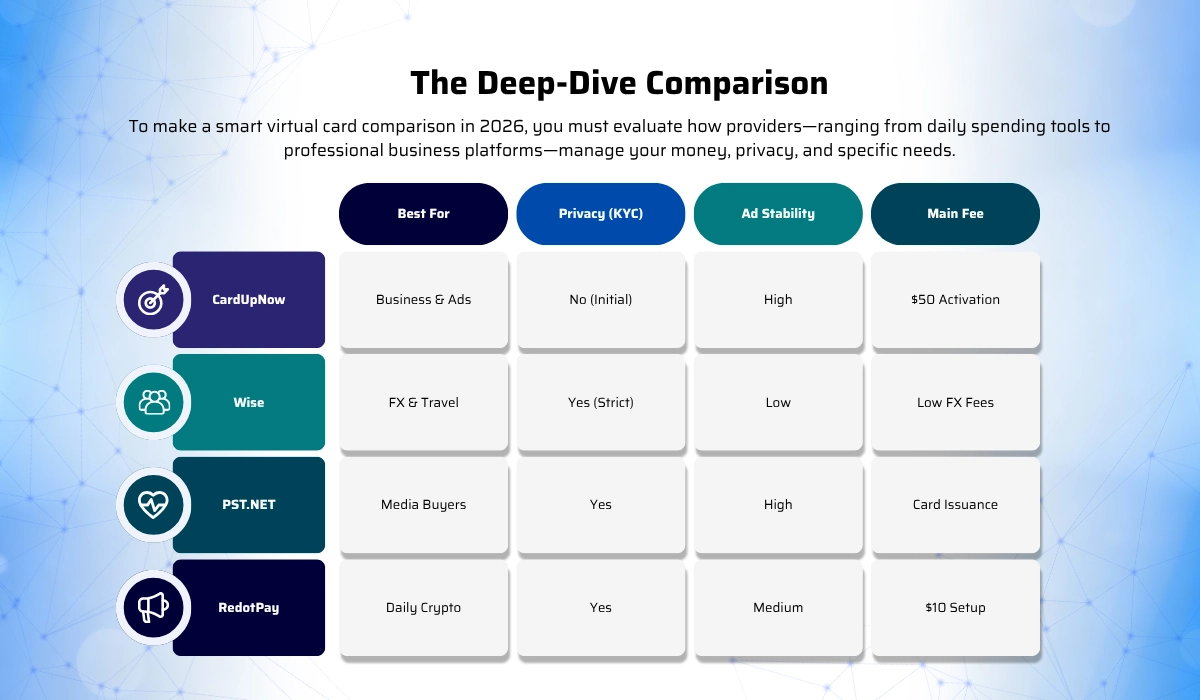
When you look at a cardupnow vs virtual card providers list, you see many names that offer different things. To make a smart virtual card comparison, you have to look at how each one handles your money, your privacy, and your specific needs. In 2026, the market is split between tools for daily spending and tools for professional business.
CardUpNow: The King of Stability
CardUpNow is the top pick for people who cannot afford a “declined” message. While other best virtual card providers might have lower startup costs, CardUpNow invests in high-quality BINs. This means their cards are less likely to be flagged as “suspicious” by sites like Facebook, Google, or high-end SaaS tools. It is a “No KYC” platform at the start, which is a massive win for users who want to keep their ID private. For power users, theCardUp Elite service provides maximum limits and support.
Wise: The Queen of Low Fees
Wise is often at the top of a prepaid card comparison for travelers. They are famous for having the lowest exchange rates. However, Wise is a regulated bank. They will ask for your ID, your address, and sometimes even proof of your income. For many who value privacy, this level of “watching” is a drawback.
PST.NET: The Ad Specialist
PST is a direct rival in the cardupnow vs virtual card providers space for marketers. They offer cards with “3D Secure,” which helps with verification. Like CardUpNow, they focus on ad stability. However, their fee structure can be complex, with different costs for different card tiers.
RedotPay: The Speed Champion
RedotPay is a crypto-first platform that offers an instant virtual card for around $10. It works well with Apple Pay and Google Pay. However, it requires a full ID scan to unlock all features. While it is faster than a bank, it doesn’t always offer the “clean BIN” reputation needed for professional ad accounts.
Pyypl: The Mobile Choice
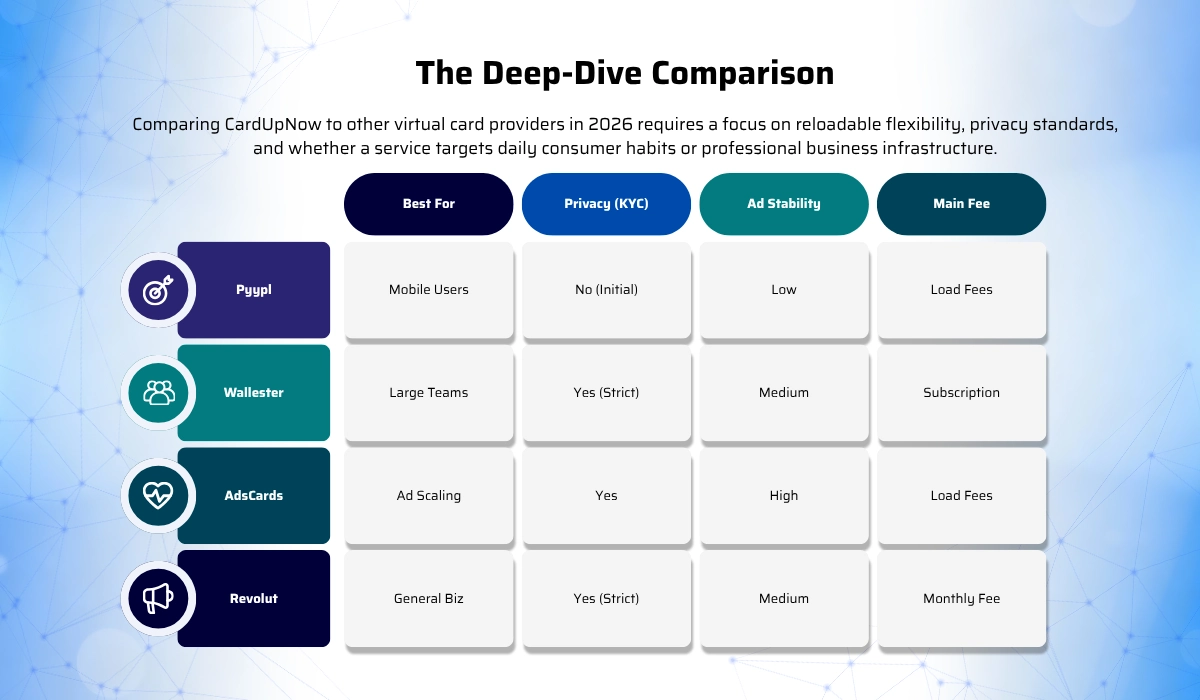
Pyypl is a virtual card app popular in the Middle East and Africa. It is very easy to use on a phone for small online buys. However, many users report that Pyypl cards get rejected more often on big ad sites compared to other best virtual card providers.
Wallester: The Team Hub
Wallester is built for big companies. It allows you to issue thousands of cards for your employees. It is great for expense tracking, but it is a European regulated entity, meaning the KYC process is very strict and time-consuming.
AdsCards: The Niche Player
AdsCards focuses purely on media buyers. They offer high-trust BINs, but their platform is less user-friendly than others. In a virtual card comparison, they are a solid choice but lack the “all-in-one” feel of more established providers.
Revolut Business: The All-In-One
Revolut offers a massive range of features, from crypto to stock trading. Their virtual cards are solid, but like Wise, they are very quick to “freeze” accounts if they see activity they don’t understand, like high-frequency ad spending.
Summary Table: CardUpNow vs Virtual Card Providers
| Provider | Best For | Privacy (KYC) | Ad Stability | Main Fee |
| CardUpNow | Business & Ads | No (Initial) | High | $50 Activation |
| Wise | FX & Travel | Yes (Strict) | Low | Low FX Fees |
| PST.NET | Media Buyers | Yes | High | Card Issuance |
| RedotPay | Daily Crypto | Yes | Medium | $10 Setup |
| Pyypl | Mobile Users | Yes | Low | Load Fees |
| Wallester | Large Teams | Yes (Strict) | Medium | Subscription |
| AdsCards | Ad Scaling | Yes | High | Load Fees |
| Revolut | General Biz | Yes (Strict) | Medium | Monthly Fee |
Virtual Visa vs Mastercard: Which One Wins?
When you are looking at the best virtual card providers, one of the first choices you will face is picking between a virtual visa vs mastercard. To the average person, these might seem exactly the same. They both have 16 digits, a CVV, and an expiry date. However, in the professional world of global payments and digital advertising, the small differences between these two networks can change how easily you spend your money.
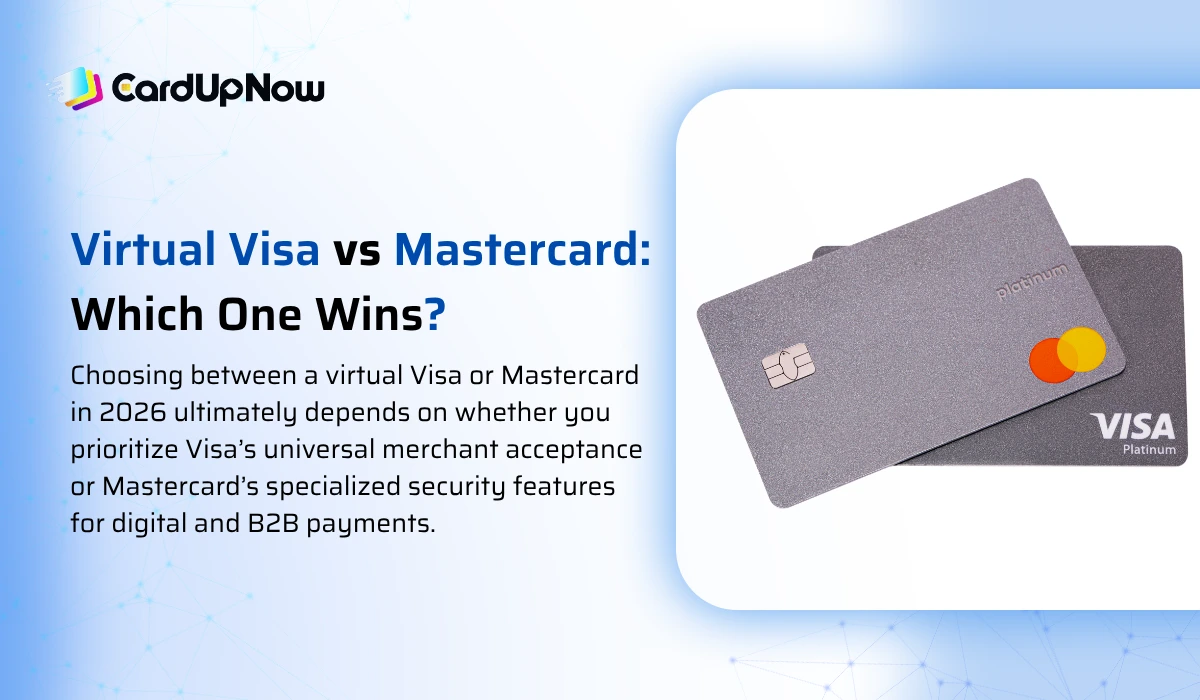
Visa and Mastercard do not actually issue the cards themselves. They are the “networks” that move the money between your virtual card provider and the merchant. In our virtual card comparison, we found that Visa is often seen as the leader in total reach. It is accepted in almost every corner of the world. For business owners running international campaigns, a virtual visa card is a safe bet because it rarely meets a merchant that doesn’t recognize it.
On the other hand, Mastercard has made huge leaps in 2026, especially in the world of technology and B2B payments. Many of the best virtual card providers choose mastercard virtual card because it offers excellent tools for “tokenization,” which adds an extra layer of security for mobile wallets. When doing a prepaid card comparison, you might notice that Mastercard is very common for crypto-linked cards.
For most users, both networks will work perfectly for Facebook Ads, Google Ads, or shopping on Amazon. The real “win” comes from the bank that issues the card, not just the logo on it. However, if you are traveling or paying unique global vendors, having one of each is the smartest way to ensure you are never stuck without a way to pay.
Fee Comparison: The Cost of Doing Business
When you are trying to find the right tool for your money, you have to look at the total cost. A “free” card can actually be very expensive if it has high hidden fees. To make a smart prepaid card comparison, you need to look at three things: how much it costs to start, how much it costs to make a card, and how much it costs to load money.
In the world of best virtual card providers, CardUpNow has a different approach. They charge a $50 one-time fee to open an account. While some other virtual card comparison options like Wise or Revolut might let you sign up for less, they often have limits that stop you from growing. For example, Wise might charge you $50 just to get your full account details, and Revolut Business plans can cost between $10 and $125 every month.
When we look at cardupnow vs virtual card providers, the “load fee” is where you see the biggest difference. CardUpNow usually charges around 5% to add money. In comparison, RedotPay charges a 1% crypto fee plus a 1.2% fee for different currencies. Pyypl can even reach over 4% in hidden markups when the market is busy.
Setting Up: How Easy is it to Start?
When you are ready to spend, you don’t want to wait for weeks of paperwork. One of the biggest differences in the cardupnow vs virtual card providers debate is how much personal information you have to share just to get started. In 2026, many people are looking for ways to stay private while managing their business or personal shopping online.
Most of the best virtual card providers, such as Wise or Revolut, require a full “Know Your Customer” (KYC) check immediately. This means you must upload a clear photo of your ID, provide proof of your home address, and sometimes even record a video of your face. For a busy person, this can take days to get approved. If your document is slightly blurry, you have to start all over again. These platforms are built like traditional banks, which makes them slow to join.
When we look at cardupnow vs virtual card providers, the speed of CardUpNow stands out. It is often described as a “low friction” platform. You can buy virtual card buy with just an email address and have your first online payment card ready in minutes. This is perfect for those who need an immediate solution for a new ad campaign or a quick purchase.
In our virtual card comparison, other crypto-first cards like RedotPay or PST.NET also try to be fast, but they usually ask for an ID scan to unlock spending limits right away. CardUpNow allows for a much smoother entry path, especially for those who value their privacy. If you want to create a virtual prepaid card today without the headache of a bank-level audit, the choice is simple.
Who Should You Pick?
Choosing between cardupnow vs virtual card providers depends entirely on what you need to do with your money. There is no “one size fits all” answer, but there is a right answer for your specific situation.
If you are a professional who runs ads or manages a high-growth business, CardUpNow is the clear winner. While other best virtual card providers focus on low fees, they often fail when it comes to account stability. CardUpNow provides the “clean” numbers you need to stay active on big platforms. It is the best choice for those who want to focus on making money rather than fighting with bank support teams.
For casual shoppers or world travelers, a virtual card comparison might lead you toward Wise or Revolut. These are great for saving a few dollars on a vacation or a small Amazon purchase. However, if you value privacy and need a card that works without a long ID check, the cardupnow vs virtual card providers debate ends with CardUpNow as the top choice.
FAQ: Questions About Cardupnow vs Virtual Card Providers
Which is the best virtual card platform for beginners?
For total beginners, Wise is very easy to use for small tasks. But if you are a beginner in the world of ads, CardUpNow is better because it prevents your accounts from getting banned.
Can I use these cards for international shopping?
Yes. In our prepaid card comparison, we found that almost all these cards work for global sites like Amazon, Netflix, and Shopify. Whether you choose a virtual visa vs mastercard, you can shop worldwide.
Do I need a bank account to get these cards?
Many of the best virtual card providers let you add money using crypto or other digital wallets. This means you don’t always need a traditional bank account to get started.
Is it safe to use cardupnow ?
Yes. These platforms use high-level encryption to keep your data safe. Using a virtual card is actually safer than using your real bank card because it protects your main savings from hackers.