Online payments have become part of everyday life. People pay for software tools, streaming platforms, online shopping, digital ads, and many other services. Most of these payments happen with debit or credit cards.
At the same time, online fraud, subscription traps, and data breaches are increasing every year. Many people hesitate to use their primary bank card on unfamiliar websites because a single leak can expose their financial information.
This is where virtual payment cards come in. They are designed to make online transactions safer and more flexible. Instead of sharing your main card details everywhere, you can generate a digital card and use it for specific payments.
Virtual cards are now widely used by freelancers, marketers, businesses, and everyday internet users. They allow people to manage subscriptions, control spending, and reduce the risk of card misuse.
What Are Virtual Payment Cards?
Virtual payment cards are digital card numbers that work just like traditional debit or credit cards. They come with the same essential details that a physical card has, including a card number, expiration date, and CVV code.
The main difference is that a virtual card exists only in digital form. There is no plastic card to carry in your wallet.
These cards can be used for online transactions on platforms that accept major payment networks like Visa and Mastercard. Many virtual cards also support global payments, subscriptions, and digital services.
When you create a virtual card through a card provider, the system generates a unique set of card details that you can use for payments. The card may be linked to a balance, a wallet, or a prepaid amount depending on the type of service.
Because the card exists digitally, users can create, manage, freeze, or delete it from their dashboard within seconds. This level of control is one of the main reasons virtual cards are growing in popularity.
How Virtual Payment Cards Work
Virtual payment cards follow the same payment infrastructure used by traditional cards. They operate through major card networks such as Visa and Mastercard.
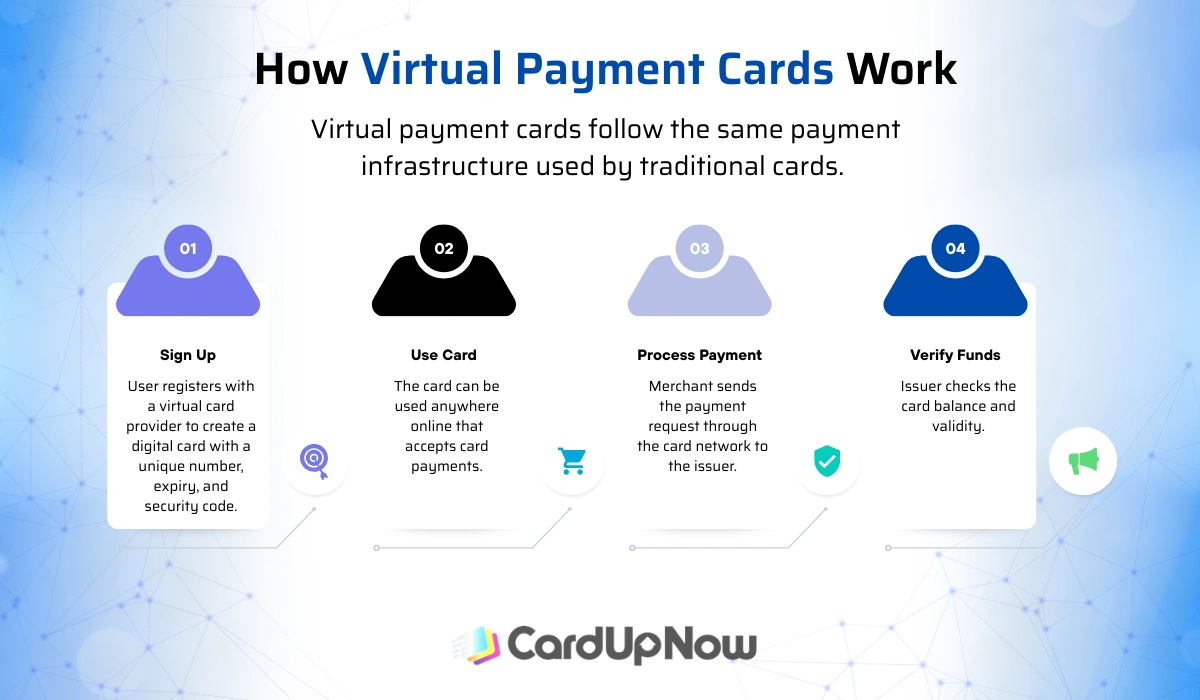
The process of using a virtual card is simple.
- First, a user signs up with a virtual card provider. The platform then generates a digital card with a unique number, expiration date, and security code.
- Once the card is created, it can be used on any website that accepts card payments. The payment process goes through the same steps as a normal card transaction.
- When a payment is made, the merchant sends the transaction request to the card network. The card network then contacts the card issuer to check the balance and verify the transaction.
- If the funds are available and the card details are valid, the payment is approved. The transaction is then completed and recorded in the user’s account.
This entire process happens within seconds. From the user’s perspective, the experience is identical to using a physical card.
Types of Virtual Payment Cards
Not all virtual cards work in the same way. Different providers offer different types of cards designed for specific use cases.
Understanding these categories can help users choose the right option for their needs.
Virtual Debit Cards
Virtual debit cards are connected to a wallet or account balance. When a payment is made, the funds are deducted directly from that balance.
These cards are commonly used for online shopping, subscriptions, and digital services.
Virtual Credit Cards
Virtual credit cards operate like traditional credit cards. Instead of using a preloaded balance, users can spend within an assigned credit limit.
Many banks offer this option to help customers protect their primary card information during online transactions.
Virtual Prepaid Cards
Prepaid virtual cards are loaded with a fixed amount of funds before they can be used. Once the balance is used, the card stops working until it is reloaded. This type of card is useful for budgeting and controlling spending.
Disposable Virtual Cards
Disposable cards are designed for one time transactions. After a single purchase, the card becomes inactive. This provides an extra layer of protection when buying from unfamiliar websites.
Key Features of Virtual Payment Cards
Virtual cards offer several features that make them attractive for modern online payments.
- One of the biggest advantages is instant card generation. Users can create a new card within seconds without waiting for a physical card to arrive.
- Another important feature is spending control. Many platforms allow users to set limits for each card. This helps prevent overspending and protects against unexpected charges.
- Virtual cards also provide better subscription management. Instead of using the same card for every service, users can assign different cards to different subscriptions. If a subscription is no longer needed, the card can be canceled easily.
- Security is another strong benefit. If a website stores card details and later experiences a data breach, the damage is limited to that specific card. The main account remains protected.
In addition, virtual cards can be created and deleted instantly. This gives users more flexibility compared to traditional cards.
Why Virtual Payment Cards Are Safer Than Traditional Cards
Online payment security is a growing concern. Cybercriminals target card details through phishing attacks, data breaches, and fake websites.
When people use their main debit or credit card for multiple services, the risk increases. If that card is compromised, attackers may gain access to the user’s primary bank account.
Virtual payment cards reduce this risk in several ways.
First, they allow users to generate separate cards for different services. If one card is compromised, the others remain safe.
Second, many virtual cards can be disabled instantly. If a suspicious transaction appears, the card can be frozen or deleted from the dashboard.
Third, disposable cards provide an extra layer of protection for one time purchases. After the transaction is completed, the card becomes inactive.
Another advantage is spending limits. Users can control how much money is available on each card. This prevents unauthorized transactions from draining the entire account.
These features make virtual cards an effective tool for improving online payment security.
Popular Use Cases of Virtual Payment Cards
Virtual cards are used in many different situations. Their flexibility makes them suitable for both individuals and businesses.
Online Shopping
Many people use virtual cards when shopping on unfamiliar websites. This protects their primary bank card from being exposed to unknown platforms.
If the website turns out to be unreliable, the virtual card can be canceled immediately.
Subscriptions and Free Trials
Subscription services are everywhere. Streaming platforms, productivity tools, and software services often require card details to activate free trials.
Virtual cards help users manage these subscriptions easily. If the service is no longer needed, the card can simply be removed.
Digital Advertising Payments
Online marketers frequently use virtual cards for advertising platforms. Each advertising account can have its own card, making budget control easier.
This approach also reduces the risk of payment interruptions if one card encounters issues.
Software and Online Tools
Freelancers and businesses often pay for cloud services, hosting, automation tools, and other digital platforms.
Virtual cards allow them to organize these expenses and track payments more effectively.
International Payments
Many global platforms require Visa or Mastercard payments. Virtual cards make it easier for users to access international services without relying on a physical bank card.
How to Create a Virtual Payment Card
Creating a virtual payment card is usually a simple process. Most platforms follow a similar setup procedure.
First, the user registers on a virtual card platform and creates an account. After completing the registration process, the user adds funds to their account or wallet.
Once the balance is available, the platform allows the user to generate a new virtual card. The system instantly provides the card number, expiration date, and CVV.
The card can then be used on websites that accept card payments.
Many modern virtual card services also provide dashboards where users can track transactions, freeze cards, and manage multiple cards from one place.
Platforms such as CardUpNow simplify this process by allowing users to generate virtual cards quickly and start using them for online payments without complicated setup procedures.
Virtual Payment Cards vs Physical Cards
| Feature | Virtual Payment Cards | Physical Cards |
| Availability | Created instantly online | Must be issued and delivered |
| Security | Can be deleted or replaced quickly | Harder to replace if compromised |
| Usage | Best for online payments | Suitable for both online and offline |
| Risk exposure | Lower due to separate card numbers | Higher if the main card is shared |
| Control | Easy to manage through dashboards | Limited control through banking apps |
Things to Consider Before Using Virtual Payment Cards
Although virtual cards offer many benefits, users should also consider a few important factors before choosing a provider.
Some platforms may charge fees for card creation, transactions, or balance management. It is important to review the pricing structure before signing up.
Refund handling is another aspect to consider. When a refund is issued to a virtual card, the processing time may depend on the platform and the merchant.
Users should also check the supported payment networks. Some cards work only on specific platforms or regions.
Finally, choosing a reliable provider is essential. A trustworthy service ensures secure transactions, transparent pricing, and reliable customer support.
Getting Started with Virtual Payment Cards
For beginners, the best approach is to start with a trusted virtual card provider that offers easy account management and transparent pricing.
After creating an account, users can add funds and generate their first virtual card. It is often helpful to create separate cards for different services such as subscriptions, online tools, or advertising platforms.
Regularly reviewing transaction history also helps maintain control over spending.
Platforms like CardUpNow make the process even easier by allowing users to generate virtual cards quickly and manage them through a simple dashboard. This gives users the flexibility to control online payments while improving security.
Conclusion
Virtual payment cards have become an important part of modern online finance. As digital payments continue to grow, people need better tools to protect their financial information and manage their spending.
These digital cards provide a practical solution by allowing users to generate secure card numbers for online transactions. They help reduce the risk of fraud, simplify subscription management, and offer greater control over spending.
From freelancers and online shoppers to businesses and marketers, many people now rely on virtual cards to handle their digital payments safely.
With the right provider, creating and managing virtual payment cards can be simple and efficient. Services like CardUpNow allow users to generate virtual Visa and Mastercard cards quickly, making online payments more secure and convenient.
Virtual Payment Cards FAQs
Are virtual payment cards safe to use online?
Yes, virtual payment cards are designed for secure online transactions. They allow users to create separate card numbers for different services, which reduces the risk of exposing their main financial account.
Can virtual payment cards be used for subscriptions?
Yes, virtual cards are commonly used for subscriptions. Many users create separate cards for each service so they can easily cancel or control recurring payments.
Do virtual payment cards work for international payments?
Most virtual payment cards that operate on major networks like Visa or Mastercard support international transactions on platforms that accept these payment methods.
Are virtual payment cards the same as prepaid cards?
Some virtual cards are prepaid, but not all. Virtual cards can also be debit based or credit based depending on the provider and how the card is funded.
Can businesses use virtual payment cards?
Yes, many businesses use virtual cards to manage expenses, pay for software tools, and control advertising budgets across multiple platforms.